TRUMP STUNNED! — SUPREME COURT RULES 8-1 THAT HE CAN… SHOCKING RULING SENDS WAVES THROUGH WASHINGTON!
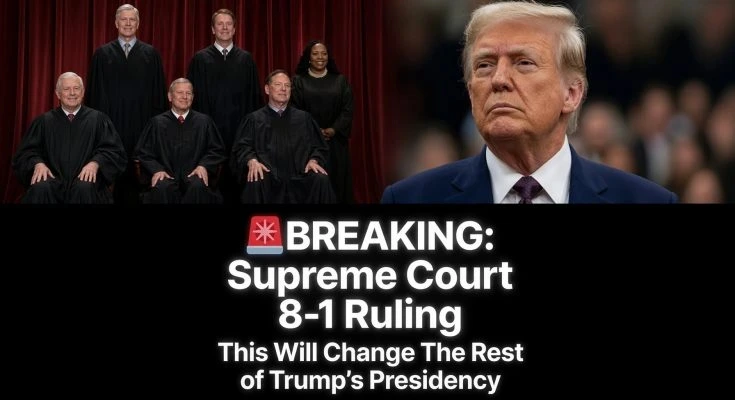
In a significant constitutional decision, the Supreme Court ruled 8-1 that federal judges lack authority to create new causes of action under the Alien Tort Statute and that the Torture Victim Protection Act does not establish secondary aiding-and-abetting liability for corporations.
What Happened
The Supreme Court issued a decision limiting the ability of courts to haul U. S. corporations into domestic courts over technology sales and commercial ties to foreign regimes. Writing for the conservative majority, Justice Amy Coney Barrett held that federal judges lack the constitutional authority to create private causes of action under the 1789 Alien Tort Statute (ATS) and that the Torture Victim Protection Act of 1991 (TVPA) does not establish secondary aiding-and-abetting liability.
Barrett was joined by Chief Justice John Roberts and Justices Clarence Thomas, Samuel Alito, Neil Gorsuch, and Brett Kavanaugh. “Today, we close the door that Sosa cracked and hold that courts may not create new causes of action for violations of international norms,” Barrett wrote, referring to the court’s 2004 precedent in Sosa v. Alvarez-Machain. “We also hold that the Torture Victim Protection Act of 1991, which contains an express cause of action, does not provide for aiding-and-abetting liability.”
The litigation originated from a lawsuit brought by unnamed practitioners of Falun Gong, a religious movement banned by the Chinese government. The plaintiffs alleged detention, and torture, aided in part by surveillance and networking infrastructure—specifically the “Golden Shield” project—engineered and sold by San Jose-based Cisco Systems and its top executives.
While a federal district court initially dismissed the complaint, the U. S. Court of Appeals for the Ninth Circuit revived the claims, ruling that both statutes permitted aiding-and-abetting actions against domestic entities that knowingly facilitate violations of customary international law. The Supreme Court’s reversal brings an end to that theory.
Emphasizing the constitutional separation of powers, Barrett reasoned that creating private rights of action is an extraordinary legislative prerogative reserved exclusively to Congress. Allowing unelected federal judges to recognize new tort claims based on evolving international norms, the majority noted, risks severe judicial encroachment on foreign policy—a realm the Constitution assigns to the executive and legislative branches. Because the ATS is strictly a jurisdictional statute and the TVPA’s text makes no mention of secondary liability, the court held that Cisco could not be held liable.
The Reaction
The decision aligns with arguments presented by the federal government. The Solicitor General’s office had participated in oral argument supporting Cisco, urging the justices to rein in extraterritorial litigation that administration officials warned could disrupt foreign diplomacy, invite reciprocal foreign litigation against U. S. interests, and chill American technological innovation abroad.
Business groups and defense counsel celebrated the decision, arguing that it removes a cloud of perpetual legal exposure for tech firms and global manufacturers operating in complex international markets. For decades, corporate defendants had faced expansive class actions under the ATS, incurring massive litigation costs to defend against claims stemming from the sovereign actions of foreign governments.
The court’s three liberal justices voiced sharp disagreement with the majority’s sweeping rollback of human rights litigation. Addressing the secondary liability question under the 1991 statute, Sotomayor argued that statutory text permitting claims against individuals who “subject” victims to abuse naturally includes those who intentionally aid and abet the underlying conduct. “Because the plain text of this statute includes individuals who aid and abet the victim’s torture, I would affirm the Ninth Circuit’s judgment on this score as well,” she wrote.
Justice Jackson, in part, joined by Kagan, offered another perspective. While Jackson agreed with narrowing aspects of the ATS’s scope, she maintained that the TVPA’s statutory framework was sufficiently broad to reach parties that provide material, knowing assistance to acts of state-sponsored torture.
What This Means
The ruling marks the culmination of a decades-long effort by conservative jurists to curtail transnational human rights suits in U. S. courts, cementing the principle that foreign policy remedies must originate in Congress rather than through judge-made tort claims.