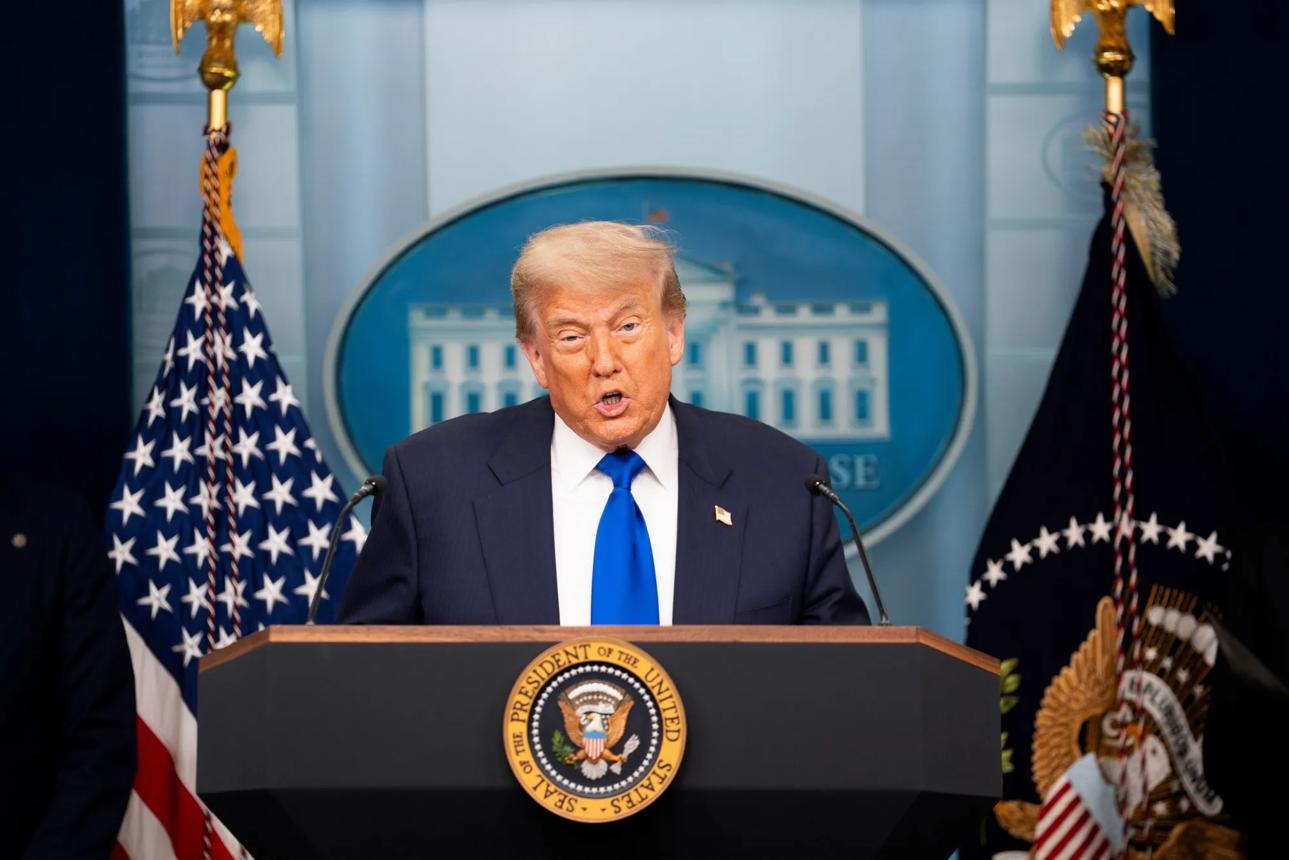
🚨 “STUPID PEOPLE” — DID TRUMP JUST INSULT HIS OWN VOTERS? VIRAL RESIGNATION CLAIM IGNITES A POLITICAL FIRESTORM BEFORE THE MIDTERMS
A provocative graphic claiming Donald Trump could leave office early if Republicans lose the midterm elections is spreading online, fueled by a headline suggesting the president does not want to govern people he considers “stupid.” But there is a major problem with the explosive claim: no authenticated recording, official transcript, or credible news report identified in the available information confirms that Trump made such a promise.
WASHINGTON — Did President Donald Trump really threaten to walk away from the White House if Republicans lose the upcoming midterm elections? Has he turned against the very voters who helped return him to power? And is a headline circulating online revealing a dramatic presidential announcement—or exploiting political anger with a claim that has not been substantiated?
Those questions are driving attention toward a viral political graphic that appears, at first glance, to deliver a stunning message from the president.
The image features Trump standing behind a debate podium beneath an attention-grabbing headline suggesting that he does not want to govern people he considers “stupid.” Its presentation evokes the style of conventional political news coverage, encouraging viewers to interpret the message as a serious statement about the president’s intentions.
But the graphic contains a crucial detail that changes how it should be understood: it was published under the BSN Network label, which describes its content as commentary, comedy and cultural absurdity.
That disclosure matters. The image should not automatically be treated as an authentic news report, and its dramatic headline is not proof that Trump has announced plans to resign if Republicans suffer electoral defeats.
The available information identifies no authenticated recording, official transcript or credible news report confirming the specific promise attributed to Trump.
In other words, the viral claim may be provocative, but the evidence presented does not establish that the president intends to leave office early.
That has not stopped the headline from raising broader questions about Trump’s relationship with his political base, the stakes of the November midterms and the increasingly blurred boundary between political satire and factual reporting.

THE HEADLINE THAT HAS PEOPLE ASKING: DID TRUMP GO TOO FAR?
The controversy begins with a familiar feature of modern political communication: a dramatic headline designed to provoke an immediate emotional reaction.
The graphic combines an image of Trump with a claim that links a supposed insult to voters with a possible early departure from office. The result suggests an extraordinary scenario in which a president might respond to electoral defeat by declaring that he no longer wants to govern the people who rejected his party.
It is a powerful premise because it touches several political nerves at once.
Trump’s supporters may interpret the message as an attack on their political identity. His critics may see it as an opportunity to question his temperament or commitment to democratic institutions. Undecided readers may wonder whether a president has made an announcement that could fundamentally change the political landscape.
But an emotionally effective headline is not the same thing as verified information.
The first question should not be whether the statement sounds like something a political figure might say. It should be whether there is reliable evidence that the statement was actually made.
In this case, the available account offers no authenticated source establishing that Trump promised to resign if Republicans lose the midterms.
The distinction is particularly important because the graphic appears to connect two separate claims: a remark involving “stupid people” and an alleged willingness to leave office early.
Even if a public figure makes a provocative comment in one context, that does not prove that the person also made a separate announcement about resigning.
Each claim needs its own evidence.
Without that evidence, readers risk accepting a dramatic political narrative simply because it combines recognizable imagery, emotionally charged language and a plausible-sounding scenario.
The graphic’s comedy disclaimer provides another reason to exercise caution. Content explicitly presented as satire or cultural commentary should not be circulated as confirmed news without independent verification.
THE “STUPID PEOPLE” REMARK: WHAT IS ACTUALLY KNOWN?
One of the most provocative elements of the viral controversy is the phrase “stupid people,” which is presented as part of the broader narrative surrounding Trump and the midterm elections.
The supplied account states that Trump criticized the prospect of what he called “stupid people” entering office during an October 15 interview with Newsmax host Rob Finnerty.
That reported remark, however, is not equivalent to saying that Trump insulted all his supporters or threatened to abandon the presidency.
The precise wording, surrounding question and full context of the interview matter. Without an authenticated recording or complete transcript available for examination, it would be inappropriate to expand the reported phrase into a sweeping claim about whom Trump meant or what he intended.
This is where viral political content can become misleading.
A quotation may be real but stripped of context. A headline may combine a genuine remark with an unsupported interpretation. A satirical publisher may deliberately exaggerate a statement to make a political point.
These possibilities are not interchangeable.
To establish whether Trump was criticizing a particular group of political candidates, discussing the quality of elected officials or referring to voters more broadly, readers would need to examine the original interview rather than rely on a graphic.
The same principle applies to the alleged resignation promise. A separate claim requires separate evidence.
A verified statement about “stupid people” cannot independently establish that Trump has threatened to leave office if his party loses congressional seats.
That distinction is especially important when the allegation involves a president’s future in office.
WHY THE MIDTERM ELECTIONS MATTER SO MUCH
The controversy arrives ahead of the November 3, 2026, midterm elections, a contest that could significantly reshape the political environment in Washington.
Midterm elections determine which candidates will serve in Congress between presidential elections. They can influence the balance of power in the House of Representatives and the Senate, affecting legislation, spending, oversight and the administration’s ability to advance its agenda.
For a president, losing congressional support can be politically damaging.
A change in control of either chamber can complicate negotiations over major legislation. A change in control of the House can also give the opposition greater power to conduct investigations, issue subpoenas through authorized processes and scrutinize executive-branch decisions.
Senate control can influence the legislative process and the consideration of presidential nominations.
Those possibilities help explain why presidents frequently campaign for candidates from their own parties during midterm election seasons.
Trump’s involvement in Republican campaigning makes the election a test of more than individual congressional races. It also provides an opportunity for voters to express approval or disapproval of the administration’s performance.
Yet the result will not be determined by presidential popularity alone.
Congressional contests involve local candidates, district-specific concerns and state-level political dynamics. Voters may support or oppose a candidate for reasons that have little to do with the president.
Issues such as healthcare, affordability, immigration and government accountability are among the subjects shaping the political debate. Economic conditions, candidate quality and turnout can also influence the results.
For Republicans, maintaining congressional majorities would help preserve legislative support for the administration. For Democrats, winning seats could create opportunities for greater oversight and a stronger role in shaping national policy.
That is the real political significance of the midterms.
The elections could change the balance of power in Washington. They do not, however, automatically end the president’s term.
CAN A PRESIDENT BE FORCED OUT SIMPLY BECAUSE HIS PARTY LOSES?
The viral graphic’s central premise raises a constitutional question that deserves a clear answer.
No. A president does not automatically leave office because his political party loses congressional elections.
The president’s term is constitutionally established. The regular presidential term ends at noon on January 20 following the relevant presidential election, under the Twentieth Amendment.
A midterm election does not reset that timetable.
If Republicans lose control of the House, the Senate or both, Trump would remain president unless a separate event changed his status under the Constitution.
A president may resign voluntarily, but such a decision would require an actual, attributable announcement and formal action—not simply an unfavorable result in congressional races.
Other constitutional processes, including impeachment and removal under the applicable requirements, are distinct from the ordinary midterm election process.
The loss of congressional majorities can substantially weaken a president’s political position. It may limit legislative options, increase oversight and intensify public criticism. But political consequences are not the same as automatic removal from office.
This is why the distinction between a viral claim and a verified presidential announcement matters so much.
If Trump genuinely announced that he planned to resign, it would represent a major national development. Such a claim would require clear evidence, including an attributable statement and reliable reporting that establishes what was said.
An image bearing a dramatic headline does not meet that standard by itself.
The constitutional framework provides a straightforward answer to the underlying question: a midterm defeat for Republicans would not, on its own, end Trump’s presidency.

HOW SATIRE CAN TURN INTO A VIRAL POLITICAL CONTROVERSY
The BSN Network label is central to evaluating the image because the publisher describes its content as commentary, comedy and cultural absurdity.
Satire often borrows the visual language of news reporting. It may use recognizable photographs, bold headlines and compressed language to exaggerate political tensions or criticize public figures.
That approach can be effective when audiences understand the joke.
Problems arise when an image travels beyond its original context.
A graphic may be reposted without the publisher’s name, disclaimer or surrounding article. A screenshot may be cropped so that the satire label disappears. Another account may share the image with a caption that presents the claim as fact.
As the content moves between platforms, viewers may encounter only the most provocative words.